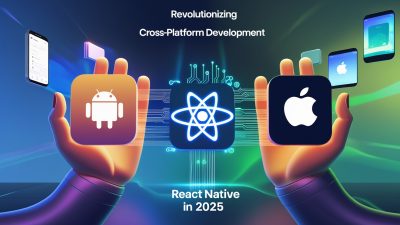
Mobile applications have become indispensable for businesses, and with the growing need to serve both Android and iOS users, cross-platform frameworks have emerged as the ideal solution. They allow developers to create apps that work seamlessly across multiple platforms, significantly reducing time and cost.
Among these frameworks, React Native and Flutter dominate the market. Both are robust, feature-rich, and offer the ability to build stunning, high-performance apps. However, choosing between React Native Development and Flutter Development requires a deep understanding of their capabilities and differences.In this blog, we’ll compare React Native vs. Flutter to help businesses and mobile app entrepreneurs make an informed decision in 2025.
Overview of React Native and Flutter
What is React Native?
Developed by Facebook, React Native is a popular framework for building cross-platform applications using JavaScript and React. It enables code reuse between Android and iOS, making development faster and more efficient.
What is Flutter?
Created by Google, Flutter is an open-source UI toolkit that uses the Dart programming language. It allows developers to build mobile app frameworks with a single codebase while providing expressive and customizable widgets for an immersive user experience.

Key Differences Between React Native and Flutter
When deciding between React Native Development and Flutter Development, several factors come into play. Below are the key areas of comparison:
Performance
- React Native: Uses a bridge to communicate with native components, which can sometimes impact performance in complex applications.
- Flutter: Delivers better performance due to its direct compilation into native code, eliminating the need for a bridge.
Development Time
- React Native: Faster development due to its JavaScript ecosystem and reusable components.
- Flutter: The hot-reload feature accelerates development but has a steeper learning curve for Dart language beginners.
UI/UX
- React Native: Relies on native UI components, providing a more platform-specific look.
- Flutter: Offers a highly customizable UI through its own widget library, ensuring consistent designs across platforms.
Community Support
- React Native: Backed by Facebook, it boasts a larger and more mature community.
- Flutter: Google’s growing support has boosted its popularity, but its community is relatively smaller.

Advantages of React Native Development
- Wider Community and Ecosystem: With a mature ecosystem, developers can find numerous third-party libraries and tools.
- JavaScript Familiarity: Leverages one of the most widely used programming languages.
- Faster Updates: Ideal for projects requiring rapid updates and deployments.
- Code Reusability: A single codebase for multiple platforms reduces development time and cost.
Advantages of Flutter Development
- Superior Performance: Flutter’s ability to compile directly into native code ensures faster execution.
- Beautiful UI Designs: Its widget-based approach provides consistent and visually appealing designs across platforms.
- Hot-Reload Feature: Developers can instantly view changes, making debugging and iteration much faster.
- Rich Documentation: Google’s detailed documentation makes it easier for developers to adopt Flutter.

Use Cases: React Native vs. Flutter
When to Choose React Native
- If your team is already experienced in JavaScript.
- When your project involves a high degree of third-party integrations.
- For apps requiring frequent updates and rapid iterations.
When to Choose Flutter
- For apps that demand high performance and a consistent UI across platforms.
- When you need to implement custom designs quickly.
- For long-term projects where Dart’s capabilities can be fully utilized.

Cost and Resource Considerations
- React Native: Hiring React Native developers is often more affordable as JavaScript is widely used.
- Flutter: Developers specialising in Dart may cost more, but the framework’s efficiency can balance development costs.

The Future of Cross-Platform Frameworks
As we step into 2025, both React Native and Flutter continue to evolve, offering new features and capabilities:
- React Native: Improved performance through concurrent rendering and community-driven updates.
- Flutter: A focus on web and desktop support, making it a more versatile framework.
The choice between these mobile app frameworks ultimately depends on your business goals, budget, and team expertise.

Conclusion
Both React Native Development and Flutter Development are excellent choices for building cross-platform applications. While React Native excels in rapid development and JavaScript compatibility, Flutter stands out for its performance and customizable UI.
Startups, CTOs, and mobile app entrepreneurs must carefully evaluate their project requirements, team expertise, and target audience before making a decision. Regardless of the framework, investing in skilled developers ensures the success of your app.
FAQs (Frequently Asked Questions)
Q1. Which is better for startups, React Native or Flutter?
A: React Native is better for startups with a JavaScript background, while Flutter suits those focusing on high performance and UI consistency.
Q2. Can I switch from React Native to Flutter for my existing app?
A: Yes, but it requires rebuilding the codebase as the two frameworks use different programming languages.
Q3. Which framework has better community support?
A: React Native has a larger and more mature community, while Flutter’s community is rapidly growing.
Q4. Are there performance differences between React Native and Flutter?
A: Flutter typically offers better performance as it compiles directly into native code, while React Native uses a bridge for communication.
Q5. How do I choose the right framework for my app?
A: Consider your app’s complexity, budget, and team expertise. For JavaScript-heavy projects, choose React Native; for superior UI, go with Flutter.