JavaScript has evolved into one of the most dominant programming languages for backend development. With a wide range of JavaScript frameworks available, choosing the right one for your backend in 2025 is crucial for building scalable backend solutions. In this article, we will compare the most popular JavaScript frameworks—Node.js, Express.js, and Next.js—to help you determine the best choice for your business needs. Additionally, we’ll discuss how hiring JavaScript developers can ensure a smooth development process for your backend projects.
Understanding JavaScript Frameworks for Backend Development
JavaScript frameworks simplify backend development by providing pre-built functionalities, better performance, and scalability. With frameworks like Node.js, Express.js, and Next.js, businesses can create powerful and high-performing web applications.
Each framework has its strengths and weaknesses, making it essential to choose the right one based on your project requirements.
🔹 Node.js – A runtime environment that allows JavaScript to run outside the browser, ideal for real-time applications.
🔹 Express.js – A lightweight framework built on Node.js, known for its flexibility and minimalistic approach.
🔹 Next.js – A full-stack framework that supports server-side rendering and API routes, making it a great choice for scalable applications.

Node.js – The Backbone of JavaScript Backend Development
Why Choose Node.js?
Node.js is an open-source, event-driven JavaScript framework designed for building scalable backend solutions. It operates on a non-blocking, asynchronous model, making it highly efficient for real-time applications.
Key Benefits of Node.js:
✅ High Performance: Runs on the V8 engine, ensuring fast execution speeds.
✅ Asynchronous Processing: Handles multiple requests without slowing down.
✅ Strong Community Support: Backed by a large number of developers and resources.
✅ Ideal for Real-Time Applications: Perfect for chat apps, gaming, and streaming services.

Express.js – The Lightweight Powerhouse for Backend Development
Why Choose Express.js?
Express.js is a minimalistic framework built on top of Node.js, allowing developers to build robust and lightweight web applications.
Key Benefits of Express.js:
✅ Minimal Setup: Provides a straightforward approach to backend development.
✅ Middleware Support: Allows custom functionalities with third-party middleware integration.
✅ High Customizability: Gives developers full control over their backend logic.
✅ Ideal for RESTful APIs: Best suited for creating lightweight API-driven applications.
Next.js – The Future of Full-Stack Development
Why Choose Next.js?
Next.js is a JavaScript framework that provides server-side rendering (SSR) and static site generation (SSG), making it an excellent choice for high-performance web applications.
Key Benefits of Next.js:
✅ Improved SEO: SSR helps web pages load faster and rank higher on search engines.
✅ Automatic Code Splitting: Enhances performance by loading only necessary JavaScript.
✅ Built-in API Routes: Allows seamless backend integration with frontend.
✅ Great for Scalable Applications: Ideal for enterprise-grade web apps.
Comparison: Which JavaScript Framework Should You Choose?
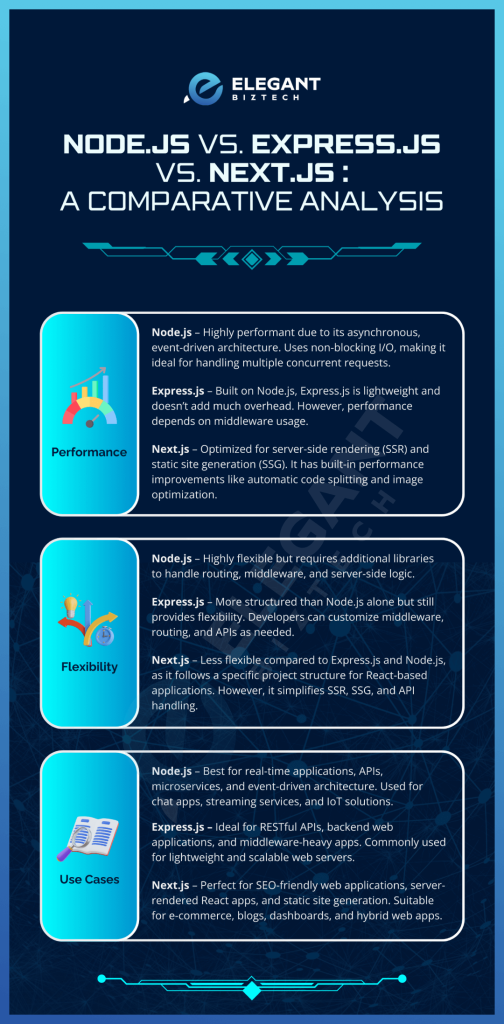
| Feature | Node.js | Express.js | Next.js |
| Performance | ⭐⭐⭐⭐⭐ | ⭐⭐⭐⭐ | ⭐⭐⭐⭐⭐ |
| Flexibility | ⭐⭐⭐⭐ | ⭐⭐⭐⭐⭐ | ⭐⭐⭐ |
| SEO-Friendly | ⭐⭐ | ⭐⭐ | ⭐⭐⭐⭐⭐ |
| Best for | Real-Time Apps | REST APIs | Scalable Web Apps |
The Importance of Hiring JavaScript Developers
Choosing the right JavaScript framework is just one part of the process. To build high-quality backend development solutions, you need experienced JavaScript developers who can leverage the strengths of these frameworks.
Why Hire JavaScript Developers?
🔹 Expertise in Scalable Solutions: Professional developers can create efficient and scalable backend architectures.
🔹 Optimization for Performance: Ensure your backend is optimized for high-speed processing.
🔹 Seamless API Integration: Build and integrate powerful APIs with frontend applications.
🔹 Security and Maintenance: Ensure best security practices to protect data and applications.

Future Trends in JavaScript Backend Development
🚀 AI-Powered Backend Services – Machine learning and AI integration will become a key aspect of backend development.
🚀 Serverless Architectures – More businesses will adopt serverless computing for cost-efficient backend solutions.
🚀 Microservices Adoption – The shift towards microservices will continue to improve backend scalability.

Conclusion: Choosing the Best JavaScript Framework for Your Backend
Selecting the right JavaScript framework for backend development depends on your project needs:
✔️ Choose Node.js if you need high performance for real-time applications.
✔️ Choose Express.js for lightweight, flexible API development.
✔️ Choose Next.js for SEO-friendly, scalable web applications.
To ensure the success of your backend projects, hire JavaScript developers with expertise in these frameworks. Their knowledge and experience will help build robust, efficient, and scalable backend solutions for your business.

FAQs
Q1. What is the best JavaScript framework for backend development in 2025?
A: Node.js, Express.js, and Next.js remain the top choices, each offering unique benefits for different backend needs.
Q2. Is Node.js better than Express.js for backend development?
A: Node.js is a runtime environment, while Express.js is a framework built on Node.js. If you need more control and minimalistic backend development, Express.js is better.
Q3. Can Next.js be used for backend development?
A: Yes! Next.js offers API routes, making it a full-stack framework that can handle backend logic.
Q4. Why should I hire JavaScript developers for my backend projects?
A: Hiring JavaScript developers ensures expert implementation of the right framework, optimized performance, and long-term scalability.
Q5. How do I choose between Node.js, Express.js, and Next.js?
A: Consider your project requirements—Node.js is best for real-time apps, Express.js is great for RESTful APIs, and Next.js is ideal for scalable applications.